
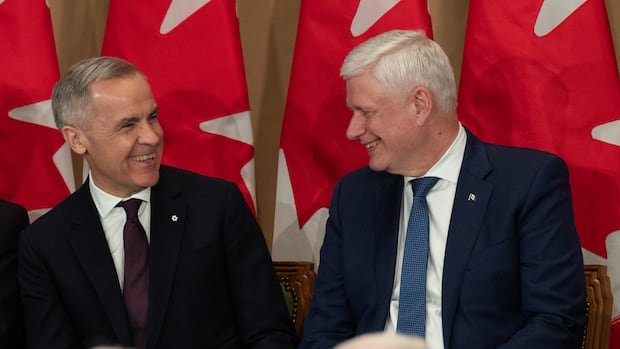
Stephen Harper, the former prime minister, revealed that in 2012, he extended an offer to Mark Carney, who was then serving as the governor of the Bank of Canada, to join his Conservative government — although not immediately as finance minister.
In his recently published memoir, Here for Canada: Memoirs of the 22nd Prime Minister, Harper states that while he informed Carney that the finance minister position was already filled, he suggested that Carney would be the top contender for the role when it eventually became available.
“Clearly, I did not propose him for the minister of finance role since it was currently occupied. However, I did indicate that if he decided to join the government, he would be the prime candidate should the position open up,” Harper notes.
In a conversation with CBC News during the 2025 Liberal leadership contest, Carney mentioned that Harper had “inquired if I would be his finance minister in 2012.” He remarked that transitioning directly from the governorship of the Bank of Canada to party politics would not be suitable at that time.
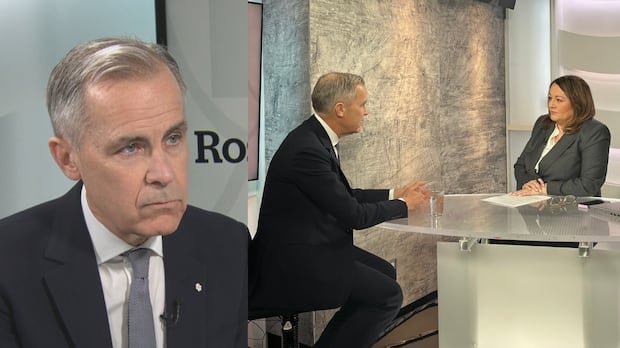
Chief political correspondent Rosemary Barton speaks with Liberal leadership candidate Mark Carney in his first Canadian interview to discuss his vision for Canada if elected.
In his memoir, which was released on Tuesday, Harper describes Carney as a “highly effective” bank governor, but notes that his finance minister, Jim Flaherty, was becoming increasingly concerned following the 2011 election that Carney might have political aspirations and could be aiming for the Liberal Party leadership — a notion that was widely speculated at the time.
“This was a significant concern for us,” Harper explains.
Harper mentioned that he discussed the situation with his chief of staff, Nigel Wright, who proposed that presenting Carney with a job offer could either secure his commitment to the government or compel him to dismiss any ambitions for a Liberal leadership run, given his non-partisan role as bank governor.
“Mark took some time to consider the opportunity, ultimately deciding that he should remain outside of partisan politics,” Harper said, adding that Carney soon thereafter accepted a position as the head of the Bank of England.
-
Mark Carney says former prime minister Stephen Harper asked him to be finance minister
-
Former prime minister Harper accuses Carney of overblowing role during financial crisis
The reference to Carney is a brief mention in the almost 650-page memoir. Harper felt it was necessary to address the topic since it has “occasionally appeared in the media.”
The book provides Harper’s insights on his political career in Canada, covering his journey from uniting the right under the modern Conservative party to a decade in governance.
Not consulted on ‘barbaric cultural practices hotline’
It also features a rare personal account of Harper’s last election campaign and the fall of his government in 2015.
The former prime minister recounts contemplating stepping down from leadership in the summer of 2014 to revitalize the party.
Harper explains that after deciding to continue leading his party into what he anticipated would be a challenging election, he resolved to serve until just after Canada’s 150th anniversary of Confederation on July 1, 2017, before initiating a leadership race.
He also notes that he only became aware of one of the most contentious moments of the 2015 campaign — the introduction of a “barbaric cultural practices hotline” — while preparing for the French leaders’ debate in Montreal, when the news “flashed across my screen.”
The proposed tip line announcement, which frustrated moderate Conservatives and complicated the party’s outreach to multicultural communities in subsequent years, was initially presented by former cabinet ministers Kellie Leitch and Chris Alexander.
Harper states that he was “furious” when he learned of this policy, which he claims he had not been consulted about and had to defend during the campaign.
The memoir covers decades of Canadian political history. It includes Harper’s accounts of face-to-face confrontations with Russian President Vladimir Putin at G8 meetings, his response to the 2008 parliamentary crisis — when opposition parties attempted to form a coalition government to oust the Conservatives — and his personal experience during the 2014 shooting incident on Parliament Hill, which occurred when he was without his usual personal security detail.
The former prime minister also provides occasional reflections on contemporary issues. Although he participated in the World Economic Forum (WEF) in Davos twice while in office, he now expresses opposition to it.
If he were in office today, Harper asserts that he would terminate Canada’s involvement in the WEF — an event he describes as having evolved from a once-valuable forum to a gathering that promotes the “narrow interests of its globalist, elitist members.”


