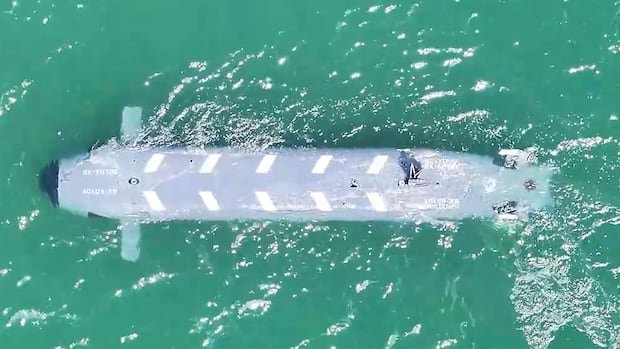
Canada boasts a coastline stretching 243,000 kilometers across three oceans and possesses approximately 20 underwater drones for its defense.
According to an internal document acquired by CBC News, defense officials discussed the necessity for a temporary solution to affirm Canada’s sovereignty last year.
However, Vice-Admiral Dan Charlebois, the commander of the Royal Canadian Navy, has confirmed that no interim solution is currently in place.
“We are still collaborating closely with industry to reach our goals. We haven’t achieved that yet,” Charlebois stated in an interview with CBC News.
The navy aimed to explore whether Canadian underwater drones could fill surveillance gaps along the “sparsely” monitored coastline until the first uncrewed underwater surveillance system is operational, as noted in the accessed document.
Currently, the navy’s limited fleet of American underwater drones is outfitted with technology developed by the Canadian firm Kraken Robotics. These drones are primarily used for mine detection and testing, rather than for surveillance.
Kraken, located in Newfoundland and Labrador, alongside Cellula Robotics in British Columbia, are recognized as leaders in underwater drone technology and are already marketing their systems for surveillance to global allies. However, they have not yet sold any to Canada.

Defense experts caution that Canada is falling behind in underwater surveillance, leaving its coastline susceptible to threats. CBC’s Ashley Burke analyzes the current surveillance capabilities and discovers the Navy is seeking a temporary solution to bridge the gaps.
Other nations are hastily advancing their efforts to monitor and safeguard crucial underwater cables from potential sabotage from adversaries.
An extensive network of these communication cables traverses the ocean floor, handling over 95 percent of global internet traffic and trillions in financial transactions. Disruptions could severely impact societies.

Numerous submarine cables stretch across the world’s ocean floors. These fiber-optic cables have reportedly been targeted by adversaries. (Kevin Kirk/CBC)
Rob Huebert, a defense expert from the University of Calgary, stated that Canada faces “significant vulnerabilities” as it cannot fully detect when adversaries enter its waters.
Huebert noted that Canada has traditionally relied on collaboration with the U.S. Navy for security, which has allowed its fleets, submarines, and satellites to age without timely upgrades.
“The fallback that Canadian governments have always depended on was, of course, if we were slow or delayed in enhancing our surveillance capabilities along the coastline, the Americans would handle it,” Huebert remarked.
He referred to this as a “policy of hope.”
The navy is currently undergoing its largest peacetime fleet renewal since World War II. However, several replacements are not expected until the 2030s and 2040s.
The Canadian government is currently in the early stages of procuring a $250-million to $499-million underwater surveillance system utilizing drones and sensors to identify, monitor, and collect intelligence on threats. This system is anticipated to be employed in Canadian waters, including the Arctic, as well as during international deployments.
“We anticipate receiving some large autonomous vehicles in the early 2030s,” Charlebois mentioned. “That timeframe is imminent when discussing the delivery of a highly advanced large-scale system.”

Vice-Admiral Dan Charlebois, commander of the Royal Canadian Navy, discusses testing drone technology. (Mathieu Theriault/CBC)
The government aims to have the system fully operational by 2043, but it remains uncertain whether foreign companies will be allowed to participate in the bidding process for the project.
When questioned about the challenges in finding a temporary solution, Charlebois acknowledged that the procurement process “can be difficult,” but he has noticed a willingness from Ottawa to reduce bureaucratic hurdles.
“The navy’s requirements can be met with products available here in Canada,” he stated. “We just need to streamline our procurement process and do it swiftly.”
Prime Minister Mark Carney has committed to accelerating procurement via the Defence Investment Agency. He has also pledged to significantly increase drone production.
Earlier this fall, Carney reported that Canada possesses around 2,000 drones in its inventory, but emphasized that millions will be necessary in the future.

Canada’s NATO partners are raising concerns about foreign adversaries suspected of damaging essential underwater cables. This network runs along the ocean floor and accounts for approximately 95 percent of the world’s internet. The threat arises at a time when Canada is contending with surveillance deficiencies along its coastline. One possible solution? Underwater drones powered by Canadian technology. The challenge? Ottawa has yet to invest in them for surveillance purposes.
Industry Minister Mélanie Joly indicated that the government is establishing a list of preapproved companies for sole-source contracts. The navy anticipates that this will present “new opportunities” for collaboration with the industry on underwater drones.
Allies utilizing technology to monitor underwater cables
Off the coast of Halifax, Dave Shea, Kraken Robotics’ executive vice-president for strategy and growth, mentioned that the slow pace of procurement has been one of the most significant hurdles his company has encountered in Canada. He expressed enthusiasm over the government’s commitment to expedite the process.
His company has equipped the navy’s limited fleet of drones with synthetic aperture sonar systems.
According to Shea, these sonar systems survey the ocean floor for notable objects and capture high-resolution imagery. Kraken’s technology is also capable of detecting submarines or vessels operating nearby.

The Kraken Robotics underwater drone Katfish is designed to be towed by a boat. It carries a synthetic aperture sonar system that can take high-resolution images of the seabed. The Royal Danish Navy, the Polish Navy, and Royal Australian Navy utilize this technology. (David Laughlin/CBC)
In recent years, Shea indicated that allied nations have shifted focus to employing their technologies to oversee whether underwater cables or pipelines have been compromised.
Canada could similarly implement these measures, he asserted, but would require a much larger fleet and long-range drones due to the extensive coastline.
“Numerous technologies developed and delivered by firms like Kraken could be utilized here in Canada to enhance our understanding of activity within our waterways, who is present in our sovereign waters, and the potential risks to safeguard Canadian capabilities,” Shea remarked.
Deliveries heading to Europe, U.S., Asia
Neil Manning, CEO of Cellula Robotics, reported that his company has sold its long-range drone to five NATO allies, yet not to Canada.
He confirmed that systems are on order and will be dispatched to Europe, the U.S., and Asia.

Cellula Robotics claims its Guardian drones are capable of executing long-endurance missions. (Submitted by Cellula Robotics)
Manning explained that Cellula employs hydrogen fuel cell technology adapted from NASA’s space launches for use underwater.
The company’s long-range drones can cover distances of up to 5,000 kilometers or remain at sea for as long as 45 days, he noted.
“I am quite optimistic that we will see domestic spending as well,” Manning stated. “However, currently, we are still in the process of building trust with our local governments.”
‘We need to advance further’
Charlebois understands that critical infrastructure is under threat elsewhere in the world and is striving to proactively address the issue.
“This is why we are collaborating more closely with Canadian industry than at any point in my 34 years in the navy because we recognize the necessity to progress further in this domain than we currently are,” he stated.

In 2021, the navy’s fleet diving unit deployed an underwater drone off the coast of Halifax to conduct mine detection exercises. (Master Cpl. Anthony Laviolette/Canadian Armed Forces)
Charlebois noted that Canada collaborates with the U.S. on underwater surveillance capabilities that provide a “very high level” of awareness, but he aims to enhance efforts and has prioritized sensor technology.
When asked about Canada’s shortcomings in safeguarding underwater infrastructure, Defence Minister David McGuinty affirmed that the government is addressing the issue.
“We are revitalizing our capacities underwater, on land, in the air, and in space,” McGuinty stated. “We are developing a comprehensive layered approach to comprehend and identify potential threats to Canada.”
The navy indicated it has a multi-layered network of capabilities to protect this infrastructure, although it acknowledged that the government, infrastructure owners, and allies share this responsibility.