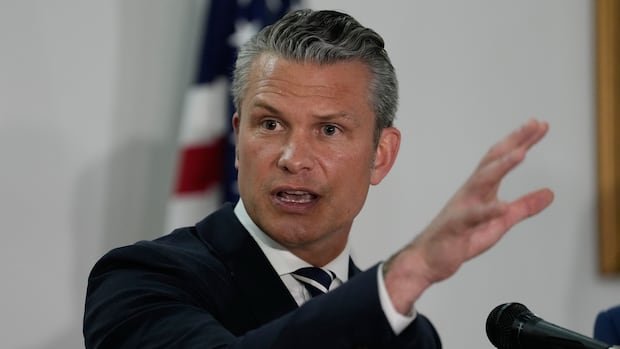
U.S. Secretary of War Pete Hegseth has allegedly issued a classified order that limits military collaboration between the United States and Canada—a development that has caught Canadian government and military officials off guard, as they have seen no indications of its implementation.
On Friday, The Washington Post reported that this directive was circulated in a secret memorandum last week, citing U.S. officials who are knowledgeable about the matter.
Three Canadian defence officials, who spoke on condition of anonymity on Saturday, acknowledged being aware of the reports and are working to verify them. They are also seeking clarification, noting that there has been no operational change in military activities between the two nations.
A Republican senator present at the Halifax International Security Forum confirmed the memo and the restrictions but minimized their significance, asserting they do not affect operations conducted by the two countries.
“It does restrict general flag officer meetings to those that further [U.S. Department of War] objectives,” remarked Sen. Mike Rounds, a member of the armed services committee.
U.S. defense personnel, both military and civilian, are now required to obtain permission before participating in social gatherings or think-tank events.
Rounds stated that the measures were drafted months prior but were only signed recently, expressing regret over their leak.
The underlying goal appears to be pressuring Canada.

U.S. Sen. Mike Rounds talks with reporters in the U.S. Capitol Building on Monday in Washington, D.C. On Saturday, Rounds confirmed the existence of Hegseth’s memo and the restrictions but played down their significance. (Finn Gomez/Getty Images)
“We genuinely want you to increase your defense spending,” Rounds stated, quickly adding that the U.S. delegation at the conference was briefed on the new measures.
“We just had an opportunity to converse with our Canadian counterparts, and they outlined their roadmap for significantly boosting their defense budget.”
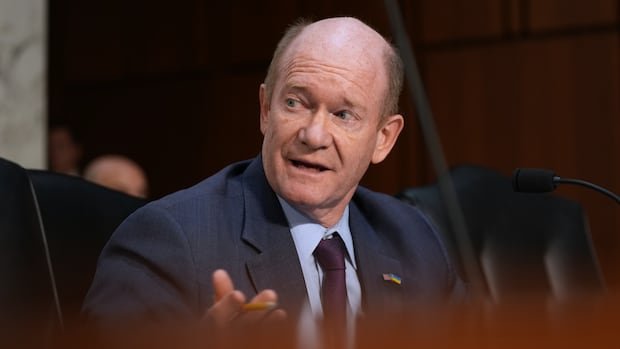
Democratic Sen. Chris Coons from Delaware expressed his frustration regarding Hegseth’s directive and its consequences for U.S.-Canada relations.
“This is an entirely unnecessary introduction of a negative tone,” Coons commented, who is also attending the Halifax forum and is on the Senate Foreign Relations Committee.
“While I’m relieved this doesn’t have a substantial operational impact, we must recognize that, as our global adversaries—Iran, North Korea, China, and Russia—become more united, the United States should avoid actions that heighten the distance and division between itself and Canada.”
-
Canada’s military is using Palantir software. What are the risks?
-
Canada looks to break Starlink’s grip on Arctic military communications
Defence Minister David McGuinty, also present at the security forum, stated that both nations continue to collaborate “hand-in-glove” on various missions, including curbing the illegal drug trade in the Caribbean and developing new policy initiatives like integrated air and missile defense.
“This is the first time we’ve heard about this—just yesterday,” said McGuinty, referencing the directive. “It’s evident that there is some document we haven’t seen yet. I’m unaware of its contents.”

Minister of National Defence David McGuinty speaks during question period in the House of Commons on Parliament Hill in Ottawa on Nov. 3. McGuinty asserts that Canada and the U.S. continue collaborating ‘hand-in-glove’ on various military missions and new policy initiatives. (Justin Tang/The Canadian Press)
According to two confidential defense sources, there was no discussion of the directive at the security forum dinner on Friday night, with one source questioning whether the congressmen and senators were even aware of it.
CBC News is not naming these sources as they were not authorized to speak publicly.
In a conversation with CBC’s Adrienne Arsenault, McGuinty mentioned he has yet to reach out to Hegseth regarding this matter. He indicated that Canadian officials are engaging with their U.S. counterparts on a range of security-related topics.
When asked if he believed any specific issues in Canada-U.S. relations might have led to the memo, McGuinty refrained from speculating, noting that Ottawa has adapted to the often unpredictable decisions of the Trump administration.

In an interview with CBC News chief correspondent Adrienne Arsenault, Defence Minister David McGuinty responded to a Washington Post report that U.S. Secretary of War Pete Hegseth has issued a classified directive restricting military co-operation between the U.S. and Canada. McGuinty declined to speculate on what may have precipitated the memo and said it was ‘business as usual’ between the two countries.
“Such unexpected developments have occurred before,” McGuinty remarked regarding the abrupt nature of the directive.
“We have learned to adapt.”
The existence of this directive could exacerbate existing tensions between the longtime allies concerning trade and defense expenditure.
Canada, U.S. working on trade deal
This action comes as the Trump administration and Prime Minister Mark Carney’s government are progressing toward a trade agreement that may provide relief in critical sectors such as automotive, steel, and aluminum.
The defense and military relationship between Canada and the U.S. is robust, well-established, and would prove challenging to restrict at an operational level without compromising U.S. security in some manner, according to one source.
- Cross Country Checkup is asking: Is it OK to start travelling to the United States again? Leave your comment here and we may read it or call you back for this Sunday’s show
The two nations collaborate on the defense of North America through NORAD. In Europe, they are founding members of NATO, working alongside the other 30 nations in the Western alliance. They also conduct joint military exercises in the Indo-Pacific region.
A third source indicated that it would also be counterproductive for Washington to limit access to U.S.-manufactured weapon systems and equipment, which the U.S. has been eager to sell and has been pressuring Canada to purchase.

Prime Minister Mark Carney stated in an interview with the New York Times that he has assessed the risk of a U.S. military attack on Canada. Matina Stevis-Gridneff, the newspaper’s Canada bureau chief, noted that Carney took several seconds—’a pregnant pause’—before responding to whether he had considered such a scenario.
Officially, the scope of Hegseth’s restrictions remains ambiguous, as reported by The Washington Post. Due to the classified nature of the memo, the Department of War has not specified which military activities or programs might be impacted.
In a statement to CBC News before Rounds’s remarks, the Pentagon’s chief spokesperson, Sean Parnell, dismissed the idea of restrictions on operational matters, but was vague regarding the specific effects of the memo.
“The Department of War is taking measures to ensure that its engagements with Canada further tangible U.S. defense objectives and ultimately foster a revitalized defense relationship,” Parnell stated in a written reply.
-
Trump says he’s working on a ‘fair’ trade deal with Canada
-
U.S. senator says Canada should make interim tariff agreement, let Congress ‘legislate’ long-term deal
“The Department of War is prioritizing opportunities for bilateral cooperation that enhance the defense of our Homelands and shared hemisphere while assisting Canada in fulfilling its NATO obligations. This guidance does not affect defense intelligence collaboration, our bi-national NORAD command, or our cooperation through NATO.”
The response left many questions regarding bilateral military exercises, training exchanges, defense planning, and other forms of collaboration.
However, Canadian officials maintain that they have yet to observe any evidence of restrictions, despite the memo having been in circulation for a week.

The Pentagon announced it has paused its involvement in a joint Canada-U.S. defense board that has existed since the 1940s, claiming Canada has not made sufficient progress on its commitments. Canada asserts it is always prepared for constructive discussions on enhancing mutual security.
Last spring, the Trump administration suspended U.S. participation in the Permanent Joint Board on Defence (PJBD) with Canada.
The suspension of the activities of this long-standing board, which serves as a bilateral advisory group coordinating continental security and recommending defense policies to both governments, was largely symbolic due to its infrequent meetings.
Canada has faced regular criticism in Washington concerning its insufficient defense spending.
There have been changes under Carney’s leadership, and Canada has now reached the NATO goal of allocating two percent of its GDP to defense.
Carney, however, has publicly expressed his desire to diversify both the nation’s trading relationships and the sources of its military equipment, indicating it is not advisable for over 70 cents of defense spending to be directed to a single market—the United States.