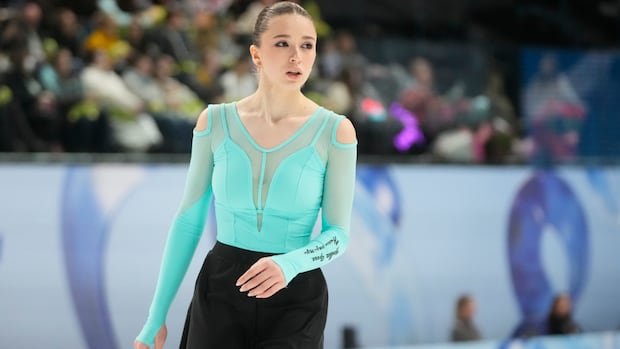
Russian figure skater Kamila Valieva has had her authorization to compete internationally as a neutral athlete withdrawn, as reported by a source familiar with the matter to The Associated Press on Saturday.
This development in Valieva’s career emerges over four years after controversies surrounding her positive doping test overshadowed the 2022 Beijing Olympics.
The source indicated that Valieva initially received neutral status based on a new rule from the International Skating Union for the current season. This rule states that athletes from Russia and Belarus are “presumed eligible unless they fall within the disqualifying criteria.”
However, Valieva’s neutral status was rescinded due to concerns regarding a potential violation of criteria that disallows skaters from being granted neutral status if they have previously endorsed Russia’s military actions in Ukraine, according to the source.
The same status has also been revoked for Russian male skater Mark Kondratiuk, who was Valieva’s teammate during the 2022 Olympics, the source added.
The ISU is expected to make a ruling on appeals from both skaters by the middle of next week. If the outcome is unchanged, the athletes will have the option to appeal to the Court of Arbitration for Sport, the source mentioned.
The individual did not wish to be identified, as the specifics of such cases are usually kept private.
The initial revocation of Valieva’s neutral status was first reported by Russian media, with Reuters also covering the story. Valieva has not publicly commented on her current status.
Following the Russian invasion of Ukraine, the ISU had prohibited skaters from Russia and Belarus from competing in 2022.
This allowed a limited number of athletes to participate in the Milan Cortina Olympics and a qualifying event last season. Two Russian figure skaters, Adeliia Petrosian and Petr Gumennik, took part in the Olympics, but neither secured a medal.
For the current season, the ISU has not imposed limits on the number of neutral athletes and has instead introduced a presumption of eligibility unless proven otherwise.
According to ISU regulations, skaters may be denied participation if they are affiliated with military or security forces, have previously engaged in military actions against Ukraine, or have “actively and publicly supported that war” since 2022.
2022 Olympic doping case
At just 15 years old, Valieva was at the center of a legal dispute during the 2022 Beijing Games when a sample she submitted two months prior tested positive for the banned substance trimetazidine.
This revelation occurred after Valieva had already helped her team secure a gold medal alongside other Russian skaters. She was subsequently disqualified from that event, resulting in the United States being awarded gold and Japan receiving silver, while the Russian team dropped from first to third. Canada finished in fourth place.
Valieva was a strong contender for the women’s gold medal but ultimately finished in fourth place and faced criticism from her coach, Eteri Tutberidze, rink-side.
She eventually served a suspension that will end in December 2025 and has since participated in competitions within Russia.
Subsequent changes to the rules raised the minimum age for skaters to 17 in preparation for the Milan Cortina Olympics earlier this year.