On Tuesday, Prime Minister Mark Carney and Chinese President Xi Jinping convened in Shenzhen, China, where they reached an agreement to enhance economic and trade relationships. This bilateral meeting led to an expansion of a tariff agreement, providing relief on approximately $400 million worth of Canadian exports, which includes specific pork and seafood items.
-
Canada and China announce new trade measures and cultural partnerships on Carney’s 1st day in Shenzhen
-
Audio
Carney floats deeper auto ties with China. What’s the risk?
In exchange, Canada has agreed to relax certain tariffs on steel and aluminum.
This agreement brings changes that affect various sectors.
Seafood
Earlier in January, Carney and Xi had already finalized a pact that resulted in China lifting tariffs on numerous agricultural and seafood goods, including a 25% tariff on lobster and crab, which was set to commence in March 2025.
On November 4, the Canadian government revealed that China would prolong the current tariff-free status for an additional two years.
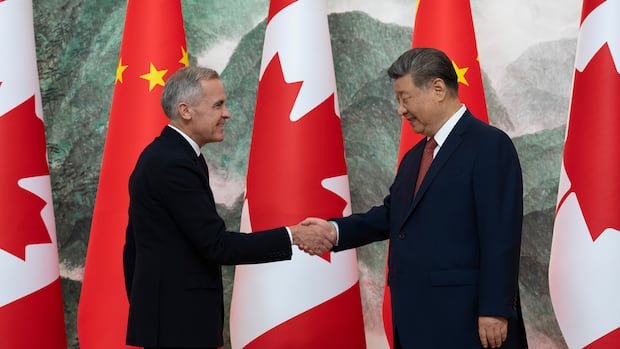
Prime Minister Mark Carney and Chinese President Xi Jinping have struck a trade deal that will see China reduce tariffs on roughly $400 million worth of Canadian exports, including frozen pork and shrimp, until 2028. In return, Canada will extend tariff exemptions for certain Chinese steel and aluminum products.
The recent announcement on Tuesday included the removal of tariffs on “certain frozen cold-water shrimp and prawns, such as Pacific spot prawn ($87.5 million); specific mollusks like geoduck ($61.4 million); sea cucumber ($39.4 million); and Greenland halibut ($96 million).”
In 2024, approximately 16% of Canada’s fish and seafood exports were directed to China.
Canola meal, peas and other crops
Similar to the relief offered in January, canola meal and peas have also received an extension this month that halted 100% tariffs.
Additionally, Tuesday’s agreement allows market entry for Canadian fava beans, chickpeas, and lentils into China.
Bill Prybylski, president of the Agricultural Producers Association of Saskatchewan, remarked earlier this month that the announcement by the federal government is excellent news for canola farmers.
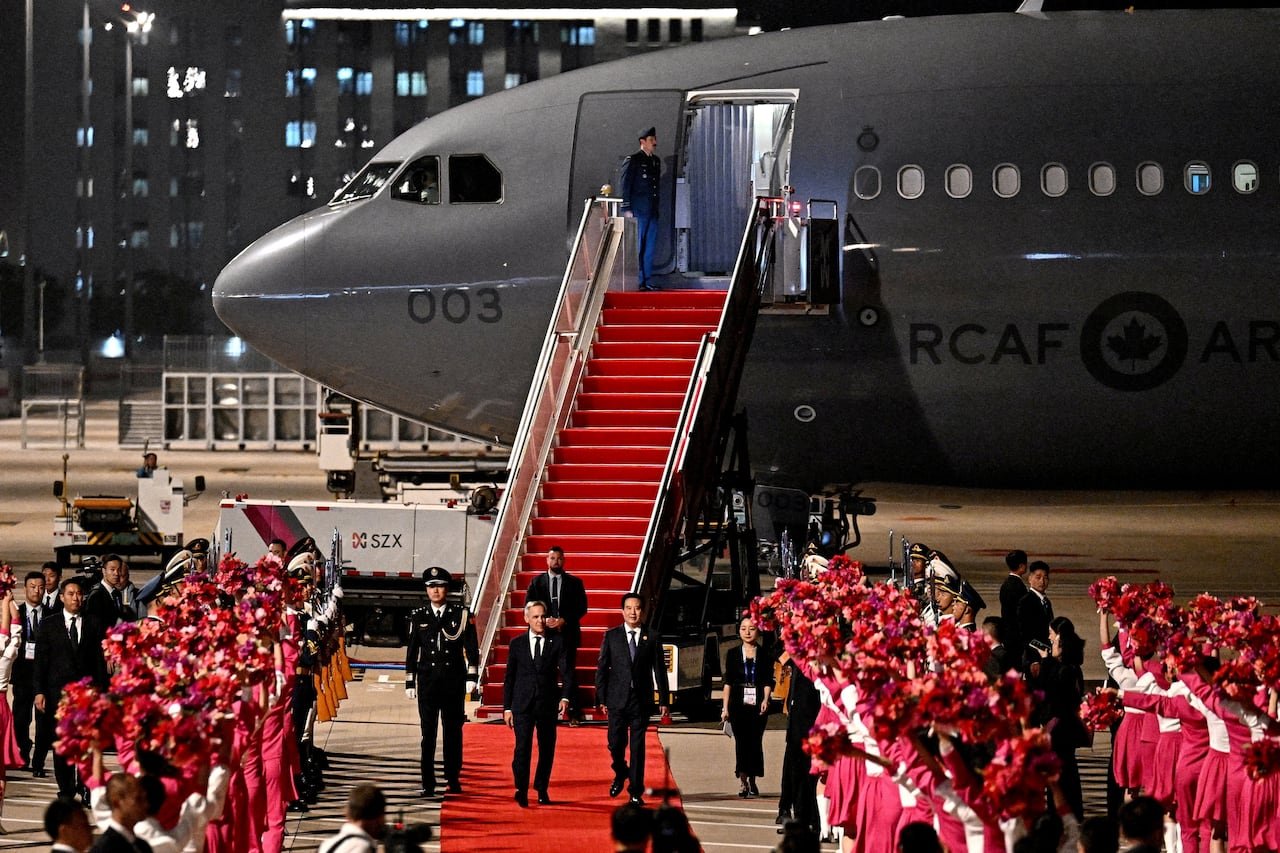
Carney arrives at the Shenzhen Bao’an International Airport ahead of the Asia-Pacific Economic Cooperation (APEC) summit in Shenzhen on Monday. (Pedro Pardo/Reuters)
He stated, “[It] provides our producers with assurance that they can proceed with plans, confident that there will be a market for canola meal.”
Chinese tariffs on canola seeds decreased from 84% to 14.9% in March, and this lower rate was maintained in the extension announced on November 4.
It is important to note that canola oil is excluded from both agreements and continues to be subject to a 100% tariff.
Prybylski has indicated that while the canola oil tariff remains a concern, it is not as critical as the capacity to sell canola meal and seeds in China.
He added, “We would like to see the tariff lifted, but for now, it’s manageable.”
Pork
While pork was not included in the January deal, the current agreement will eliminate tariffs on “most frozen pork cuts,” valued at $116 million, effective until at least December 31, 2028, which is also the new expiration date for the entire tariff arrangements.
The pork industry has welcomed this new deal as a significant move towards regaining some market access lost due to prolonged diplomatic tensions.
Before the tariffs in 2024, Canada exported pork products worth $468.6 million to China.
-
Analysis
How China is positioning itself as a global leader as it hosts Trump, Putin
-
Manitoba’s pork industry hopeful after key states flipped from red to blue in U.S. midterms
The Canadian Meat Advocacy Office, located in Beijing, expressed approval for the increased access for pork but pointed out that offal remains prohibited. Offal refers to the internal, non-muscle parts of an animal, such as organs and entrails.
Kyle Larkin, CEO of the Canadian Meat Council, noted that the Chinese market is highly profitable, partly due to the wide variety of meat cuts consumed there.
He stated, “There’s a vast consumer base in China that enjoys items like feet, head, various offal, kidneys, hearts, etc., which are not as popular among Canadian consumers.”
Steel and aluminum
In exchange for the aforementioned tariff relief, Canada has agreed to prolong tariff relief known as remission on select Chinese steel and aluminum products until December 31, 2028, which were set to expire at the end of this year.
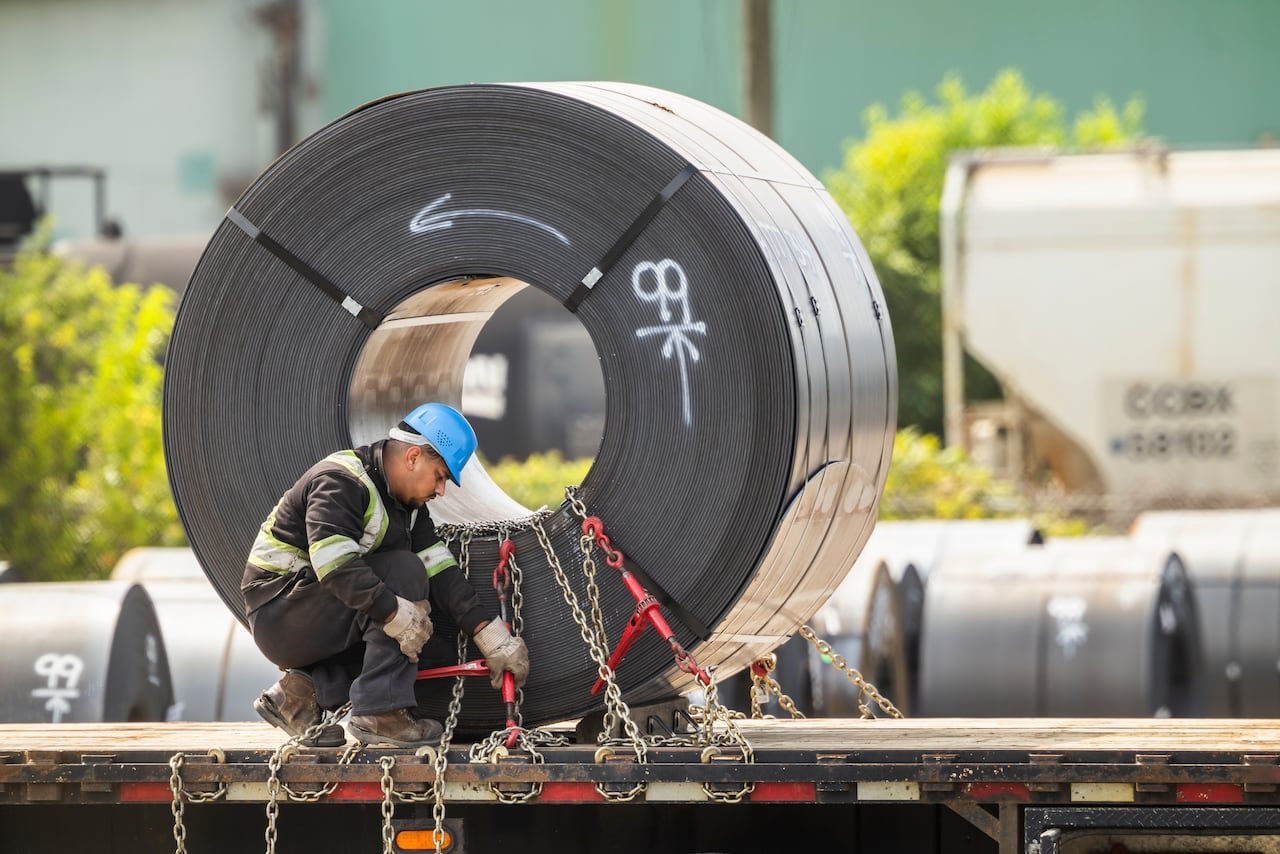
A worker secures a rolled coil of steel on a flatbed truck in at the ArcelorMittal Dofasco steel plant in Hamilton, Ont., on Aug. 20. (Nick Iwanyshyn/The Canadian Press)
Tuesday’s agreement introduces 32 new items to the remission list, comprising 23 steel tariff items and nine aluminum tariff items, for products that the Canadian government has identified as “insufficient or unavailable.”
CBC News has contacted the Canadian Steel Producers Association and the Aluminum Association of Canada for comments.
Electric vehicles
In the January agreement, Carney permitted the entry of tens of thousands of Chinese electric vehicles into Canada at lower tariffs.
Canada reduced its 100% tariff on Chinese electric vehicles to 6.1%, initially allowing for up to 49,000 vehicles per year, with the limit increasing to 70,000 vehicles over five years. Since then, Chinese manufacturers BYD, Geely, and Chery have initiated efforts to enter the Canadian market.
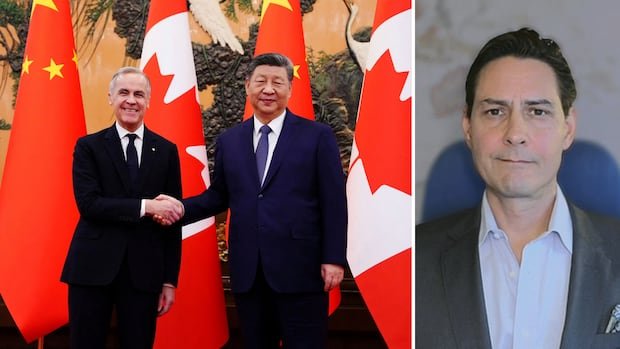
The trade relationship between Canada and China, while important, needs to be carefully managed, says Michael Kovrig, a former diplomat who was held captive in China on spying allegations for more than 1,000 days. He says the gains in Prime Minister Mark Carney’s new trade deal are asymmetrical and benefit China far more than Canada.