As Prime Minister Mark Carney aims to forge a “distinct partnership” with the European Union, Canada’s ambassador has dismissed the notion of contributing directly to the budget of the 27-member bloc.
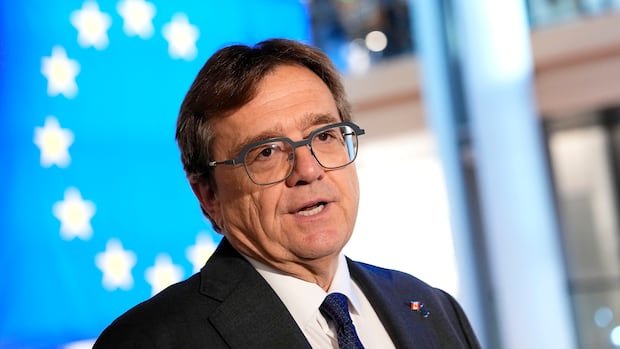
“We would be highly selective,” Canada’s soon-to-be EU ambassador Jonathan Wilkinson stated in an interview with CBC’s The House, which aired on Saturday morning. “This isn’t a blanket approach. It definitely does not equate to EU membership.”
Nevertheless, Wilkinson acknowledged that there are initiatives that might necessitate some level of funding. He cited the EU’s Security Action for Europe (SAFE) program, which provides loans to member states for defense-related investments, as an example.
Canada is presently the sole non-European nation participating in this program. Wilkinson mentioned additional fields for collaboration, such as boosting Canada’s capability to export critical minerals through European investments or partnering with the EU on artificial intelligence and other digital technologies.
“There are several specific sectors that the prime minister has identified as strategic capabilities — essential areas where nations must have access to resources that empower them to make independent decisions,” Wilkinson explained, as he prepares to officially take on his new position in the coming weeks.
Carney formally expressed his desire to strengthen Canada’s ties with the EU during his address to the European Parliament on Thursday. He unveiled several aspects of his vision, which include:
- “Seamless, digital” commerce in non-agricultural goods and services.
- Canadian involvement in Erasmus+, the EU’s program aimed at enhancing education, training, youth, and sports in Europe, encompassing cross-border student exchanges.
- Canadian participation in the next iteration of Horizon, the EU’s research and innovation funding initiative. Canada currently has limited access to the existing program, which concludes in 2027.
- Collaboration on computing power, broadband infrastructure, and AI safety measures.
- Investigating a unified market for financial services.
However, it remains uncertain whether Canada will need to concede anything in exchange, or if EU member states and the Canadian Parliament will endorse the agreement. Carney has committed to a parliamentary vote and discussion regarding the framework of any alliance with the EU.
Wilkinson expressed that he would proceed “very cautiously” regarding concerns raised by some opposition parties, such as the possibility of Canada needing to alter its immigration policies.
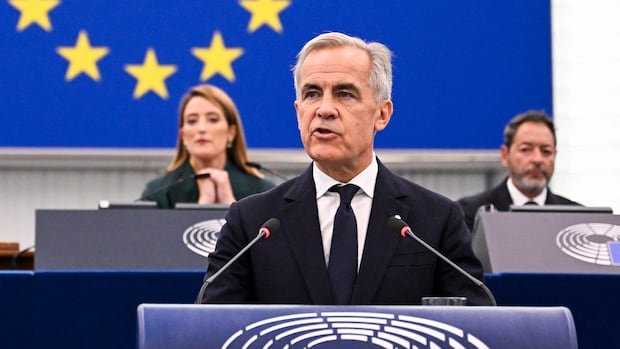
The day after the potential for Canada to become an ‘associate member’ of the EU was introduced, Prime Minister Mark Carney spoke to the European Parliament, emphasizing stronger ties with Europe, though uncertainties linger about the specifics.
“Are we discussing an extensive ability to traverse between the two regions? No, and the notion that this is somehow linked to irregular migration issues in Europe… the borders in Canada are quite distinct from those in Europe,” Wilkinson remarked.
“Canada will fully maintain its sovereignty.”
European leaders share their thoughts
Thomas Byrne, Ireland’s minister of state for European affairs and defense, mentioned to The House that both parties share numerous commonalities, including commitments to democracy, free trade, and the rule of law.
“We recognize that the U.S.A. is less committed to the kind of tariff-free trade we advocate than it once was. Therefore, we must cultivate alternative connections,” Byrne expressed. “This creates a level of commonality between us.”
- Cross Country Checkup is asking: Is Canada more like Europe than the United States? What’s at stake for you if Canada builds closer ties to the EU? Leave your comment here and we may read it or call you back for Sunday’s show
Byrne also stated that the current focus seems to be on mutual advantages for both parties rather than imposing obligations upon one another.
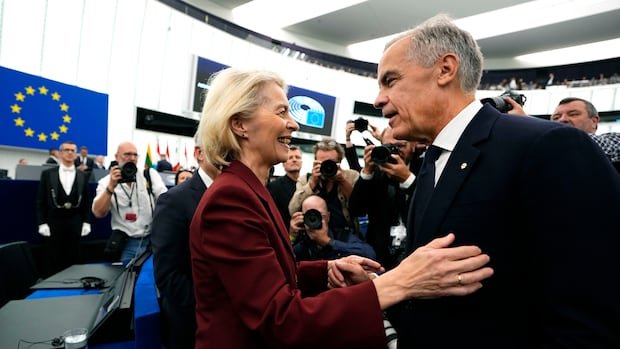
Prime Minister Mark Carney addressed the European Parliament on Thursday, asserting that a partnership between Canada and Europe would ‘protect our abilities to live our lives as we choose.’ Roland Paris, former foreign policy adviser to Justin Trudeau, and Arash Saeidi, a member of the European Parliament, discuss the potential of a Canada-European Union alliance.
“We are equal partners across the Atlantic,” Byrne asserted.
Conversely, Arash Saeidi, a European Parliament member from France, expressed skepticism about the proposal, suggesting that “if we engage in discussions on this, we will waste time, and it will drag on for ten years without any progress.”
Saeidi advocated for prioritizing efforts to strengthen connections in diplomacy, culture, and academic research instead of deliberating a formal process.
The Influence of Trump
A significant obstacle to Carney’s initiative is U.S. President Donald Trump, who labeled the pursuit of closer Canada-EU relations as “ridiculous” and subsequently threatened to impose new tariffs if it is perceived as “a hostile act.”
“It is reasonable to state that Europe will act in accordance with its own interests,” commented Fen Osler Hampson, co-chair of the Expert Group on Canada-U.S. Relations.
“Many Europeans are already advocating for increased European strategic autonomy from the United States for similar reasons to ours.”
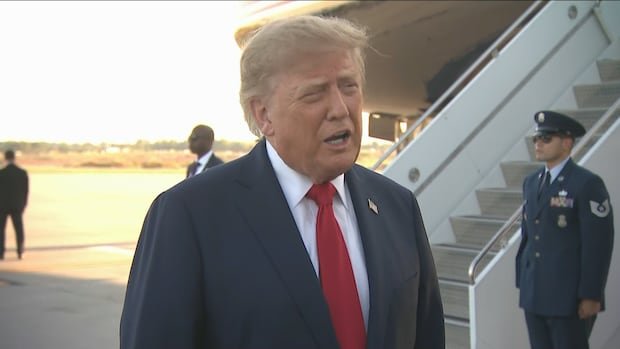
U.S. President Donald Trump threatened the European Union with ‘very serious tariffs’ or to ‘stop trading’ if it engages in a trade deal with Canada ‘with bad intentions.’
Hampson pointed out that Trump should keep in mind that both Europe and Canada are significant investors in U.S. equity markets, and Canada possesses a considerable amount of U.S. debt.
“So when he speaks about cutting off trade… if he follows through, he’s harming himself significantly,” he added.
When asked if Trump’s threats might deter the EU from reaching an agreement with Canada, Wilkinson remarked, “I suppose it’s up to the Europeans,” but he is skeptical that this will happen.
-
FRONT BURNER
Is a shaky U.S. bond market good for Canada?
-
Far-right German politician heckles Carney with ‘U.S.A.’ chant before EU address
Carney clarified that Canada is not “proposing to form a third bloc to become a global power — merely with better manners,” during his address.
“We do not seek dominance over others. On the contrary, we are striving for resilience so that no one, no one can control our open markets, compromise our sovereignty, threaten our territorial integrity, or undermine our freedoms, our democracies, and our rule of law.”
Tag: rewrite-pending