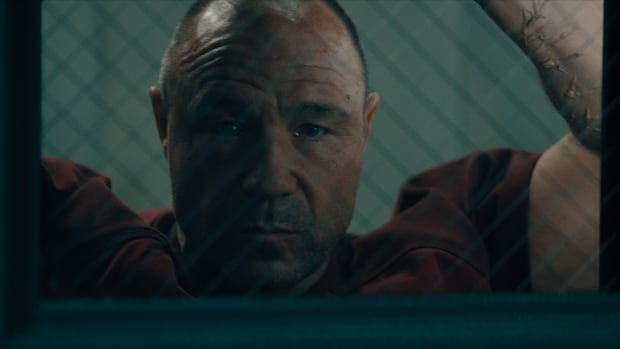
If it weren’t for Stephen Graham, known for his role in Adolescence as a deceitful and ominous serial killer, you may not have come across Nocturne.
However, considering this is an Apple TV production, it’s possible that you might not have heard of it at all. This is not to imply that the streaming service lacks noteworthy content; just ask anyone who is captivated by Slow Horses or eagerly anticipating the next season of Severance.
For every standout like Ted Lasso, there appears to be a couple of forgettable titles like Cape Fear: typical streaming options that, despite their substantial budgets and competent production, fail to create a strong case for viewing.
Should you decide to engage with it, you’ll find enough functional storytelling and well-lit visuals to draw you into habitual watching. It’s only after a few episodes of uninspired twists that you might pause and ponder: “Why am I even watching this?”
This sentiment could well encapsulate Nocturne. Based on the crime novels The Sandman and Lazarus by Lars Kepler, it adheres closely to the formula of its “Nordic noir” predecessors, to an almost painful extent.
Initially, we are presented with a disturbingly typical mystery. Who is behind the abductions and burying of individuals alive, providing just enough sustenance to ensure a slow demise? And why has young Michael (Landon Valentin) returned to town, disoriented, years after he and his sister vanished?
Jurek Walter (Graham) stands out as the prime suspect, given his prior conviction for similar crimes. Yet, aside from his almost supernatural ability to manipulate his surroundings—evidenced by convincing a fellow inmate to injure himself—Walter hasn’t had much chance to cause chaos recently. Not to mention, he has been confined to a psychiatric facility for years.
This sets the stage for unraveling the mystery, intertwined with the necessary emotional depth and a dizzyingly complex array of characters. Jonah Lynn (Liev Schreiber) is the troubled former cop who originally incarcerated Walter. FBI agent and undercover operative Saga Bauer (Zazie Beetz) — who acts as Lynn’s surrogate daughter — is tasked with infiltrating the psychiatric hospital as a patient to get closer to Walter.
Additionally, there’s the anxious yet well-meaning nurse Karl (Rory Culkin), who covertly delivers Walter’s letters to his attorney while clearly falling under the killer’s manipulative charm. Moreover, we have the competent yet dysfunctional FBI agent/mother Alexandra Quinn (Poorna Jagannathan); the well-intentioned but bumbling police chief Dave Ellison (Bill Camp); and Michael’s fiercely dedicated yet struggling mother, Ida (Chrissy Metz).
Each character grapples with past traumas and deep-seated pain, all intertwined in the intricate plot to rescue Michael’s sister Felicia before it’s too late — assuming she hasn’t already perished.
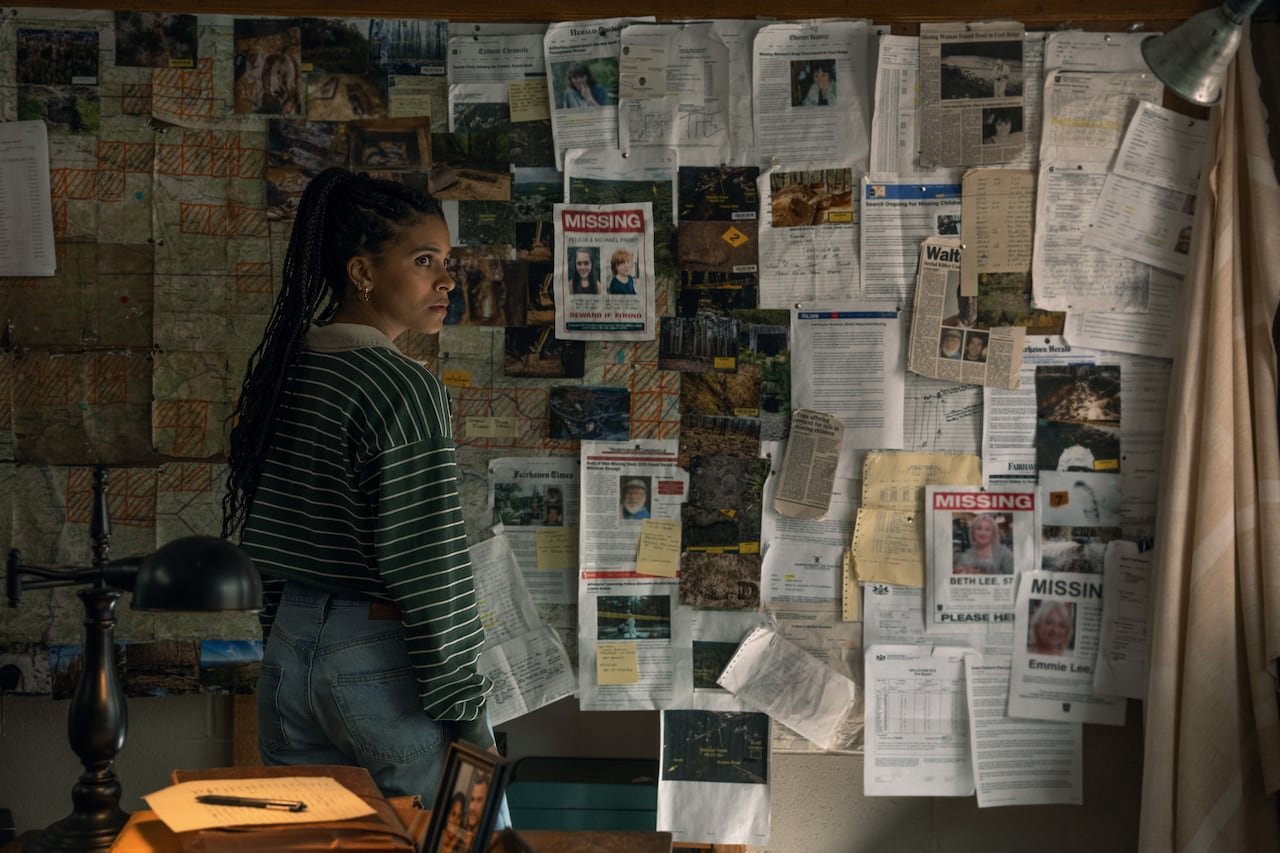
Zazie Beetz as Saga Bauer in a still from Nocturne. (Apple TV)
Thus, the essential elements of Nordic noir are fulfilled. Relocated from the books’ Swedish backdrop to a quaint Pennsylvania town, the dark and dreary aesthetics remain prominent. Every character wears a visibly tormented expression.
Not a single day passes without a heavy, grey color palette — the sky seemingly perpetually on the brink of a torrential downpour. Additionally, any attempt at altruism is met with harsh consequences by a cruel universe — at least within the first two episodes of the ten-part series that premiered on Friday.
Despite the abundance of clichés, Nocturne benefits from Graham’s performance. He portrays a character that resembles a modern-day Hannibal Lecter: a shape-shifting manipulator who sometimes seems so emotionally detached that you question his awareness; and at other moments, he delivers such a compelling display of empathy that you start to wonder how easily someone like him could dominate you.
On one hand, Graham’s disturbingly captivating performance injects a degree of originality into Nocturne; on the other hand, the painfully restrained portrayal of evil does little to enhance the show’s dramatic effect. While it might position Walter in competition with No Country for Old Men‘s Anton Chigurh for the title of most believable psychopath on screen, it doesn’t render him the most entertaining character.
As the narrative shifts between intertwined plotlines — avoiding the overly dramatic tone of the Hannibal series, which Nocturne clearly draws inspiration from — Walter’s strange, clown-like laughter and subtle indicators of violent tendencies often get lost amidst the clutter.
What stands out more is the aimless voyeurism characteristic of the other genre Nocturne imitates: true crime.
Graham himself has shared that his research involved watching crime documentaries, while Apple TV has chosen to promote the series in a similar vein. “If you enjoy true crime, this show is for you,” each advertisement insists; a claim that Nocturne appears crafted to fulfill.
This is primarily due to the fact that — regardless of the ethical implications of turning crime into entertainment — most true crime productions share a fundamental flaw: dressing up minor incidents as universally significant and then artificially prolonging the mystery to create an unnecessarily lengthy final product.
As more characters become ensnared in an improbably convoluted crime, Nocturne increasingly resembles a documentary you simply didn’t finish. Assuming the series adheres to the novels’ storyline, it culminates in a predictably laughable twist — one that would make skipping it the most time-efficient option.
With only two episodes currently available, it might be premature to conclude. Nocturne’s gradual build-up may transform into something worthwhile, as Graham’s performance and the intriguing mystery at the heart of Nocturne provide just enough allure to engage viewers.
Nevertheless, if you’re truly in search of an enjoyable experience, The Silence of the Lambs is readily available.