U.S. President Donald Trump suggested that a trade agreement with Canada could be finalized soon, although he indicated that additional efforts are necessary to achieve this goal.
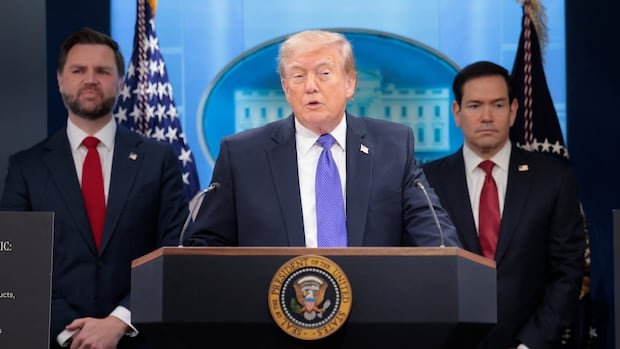
During a press briefing at the White House on Friday, following his trip to Asia where he had a short meeting with Prime Minister Mark Carney, Trump stated that he is in the process of negotiating a trade deal with Canada.
“While there is still much work to be completed regarding Canada, Prime Minister Carney was quite amicable,” Trump informed the media. “One of his proposals is to construct a Keystone pipeline for us — and we appreciate that. However, we must do much more than just that.”
Trump reiterated some of his common complaints, alleging that Canada has been taking advantage of the U.S. for many years and asserting that the U.S. does not require energy, vehicles, or timber from Canada.
“That being said, we are striving to create a fair agreement,” Trump added.
The U.S. president expressed dissatisfaction with the trade deficit with Canada, estimating it to be “approximately $80 billion.” This figure is closer to the actual goods trade deficit of $48 billion US for 2025 than the frequently cited $200 billion.
“I said, when it reaches zero, come over and we can begin discussions,” Trump stated.
These remarks from Trump arise as the Carney administration is pursuing an interim agreement with the U.S. aimed at reducing some of the harsh tariffs on Canadian exports.

Prime Minister Mark Carney spoke briefly with U.S. President Donald Trump at the APEC summit in China as Canadian negotiators pursue an interim deal to secure relief from U.S. tariffs by the end of the year.
Negotiators from Ottawa are seeking to eliminate the 50 percent tariffs on various Canadian exports that the Trump administration imposed in August, as well as to alleviate sector-specific tariffs that have severely impacted Canada’s steel, aluminum, automobile, and forestry sectors.
They are also aiming to prevent Trump’s threat to increase tariffs on vehicles and auto parts to 50 percent starting January 1. Although this deadline is approaching in just six weeks, the U.S. has yet to issue a formal notice regarding the threat mentioned by the president in a social media post from August.
‘Move the ball forward’
Trump conducted his press conference with Secretary of State Marco Rubio and Vice-President JD Vance present.
In his own statements, Rubio addressed the “unfairness and imbalance” in trade relations with Canada.
“The president had the chance to meet with the prime minister and advance discussions toward a final agreement that is beneficial for American workers and equitable for the United States,” Rubio noted.
Chris Galdieri, a political science professor at Saint Anselm College in Manchester, N.H., stated that he believes it would be advantageous for both nations to reach a trade deal that ensures stability.
“It is evident that the tariffs imposed on Canada have not produced the results that Trump anticipated,” Galdieri remarked on CBC News Network Friday.
“He likely assumed that these would quickly generate a surge of revenue, inflict no harm to anyone in the U.S.—especially U.S. consumers—and compel Canada to submit to the pressures of the tariffs. That has not transpired,” Galdieri explained.
“If a lasting agreement could be established, at least for the remainder of Trump’s presidency, it would allow him to feel as though he could declare success and move on.”
On Wednesday, Carney informed the New York Times’ DealBook summit that Canada and the U.S. had made strides toward an agreement in recent weeks, but he cautioned, “We’re not there yet.”
Canada-U.S. Trade Minister Dominic LeBlanc mentioned on the CBC’s Power & Politics on Thursday that an interim deal with the Trump administration would likely incorporate some level of Section 232 tariffs on steel, aluminum, auto, and lumber, though at reduced rates.
‘If you can get an interim deal, I’d take it’
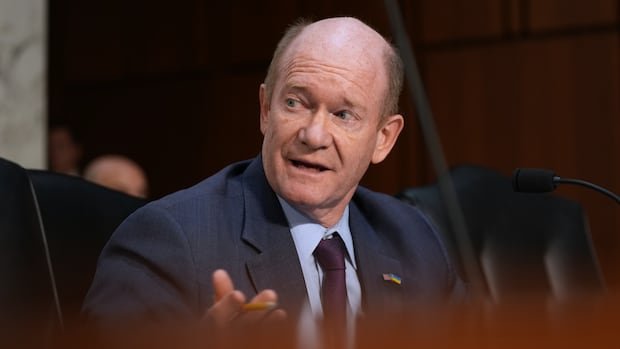
Democratic Senator Chris Coons of Delaware remarked that eliminating the 50 percent tariffs imposed by Trump in August would be a notable achievement for Canada, potentially paving the way for further developments once the Democrats gain control of Congress in January.
“Honestly, if you can secure an interim deal, I would accept it and then present it to us in the new majority to legislate an even better long-term agreement,” Coons stated during his appearance on CBC’s Power & Politics on Friday.
“We need Congress to hold Trump accountable, to cease the derogatory remarks towards our trusted and valued allies and partners in Canada.”
This press conference marked Trump’s first comprehensive briefing following his party’s significant losses in the midterm elections two weeks ago, which resulted in the Republican Party losing control of both the U.S. Senate and House of Representatives.

Data centre development is exploding across Ohio, and it’s a growing problem for U.S. President Donald Trump and his Republican Party. For The National, CBC’s Katie Simpson goes to the crucial battleground state to find out more about how it could play out in the upcoming midterm elections.
He also introduced an unexpected policy that could influence Canada’s efforts to attract investment in artificial intelligence from U.S. tech companies.
Without going into specifics, Trump mentioned that U.S. firms would incur an unspecified tax if they establish their AI data centers overseas.
“We will not permit our companies to set up data centers outside of our nation,” he asserted. “We will impose a significant tax on them if they do so.”
The potential effect of Trump’s proposal, which he stated he had not disclosed to his senior staff, on two major data center initiatives in Canada funded by U.S. tech giants Meta and Anthropic remains uncertain.
Meta announced in July its intention to invest $13 billion to build a large data center northeast of Edmonton, marking its inaugural project in Canada.
Anthropic revealed in October that it has secured a 20-year lease for a data center currently in the pre-construction phase in Cape Breton.
The rapid expansion of data centers in the U.S. has become a contentious issue during the midterms, with both Democrats and Republicans unifying against such developments in their localities.