Michelle Connolly, a forest disturbance ecologist based in Prince George, B.C., dedicates much of her time to preserving forest ecosystems from industrial encroachment.
However, Connolly has temporarily swapped her hiking boots for swim fins.
Since early August, she has been part of a relay team swimming the 1,375-kilometre stretch of the Fraser River to raise awareness about the significance of safeguarding the Fraser watershed. By the end of the swim, the team will have immersed themselves in the river nearly every day for about a month.
The Fraser Riverkeeper Society, the organization organizing the swim, describes the Fraser as “one of the world’s great salmon-bearing rivers and one of the last significant wild rivers anywhere.”
For Connolly, participating in daily swims offers a distinctive viewpoint on the conservation efforts for the river and its surrounding lands.
“Experiencing the water transforms everything,” she remarked during a break in Prince George. “You gain insights into the landscape from the perspective of an aquatic inhabitant. You can deeply connect with what truly sustains B.C., which is the Fraser River.”
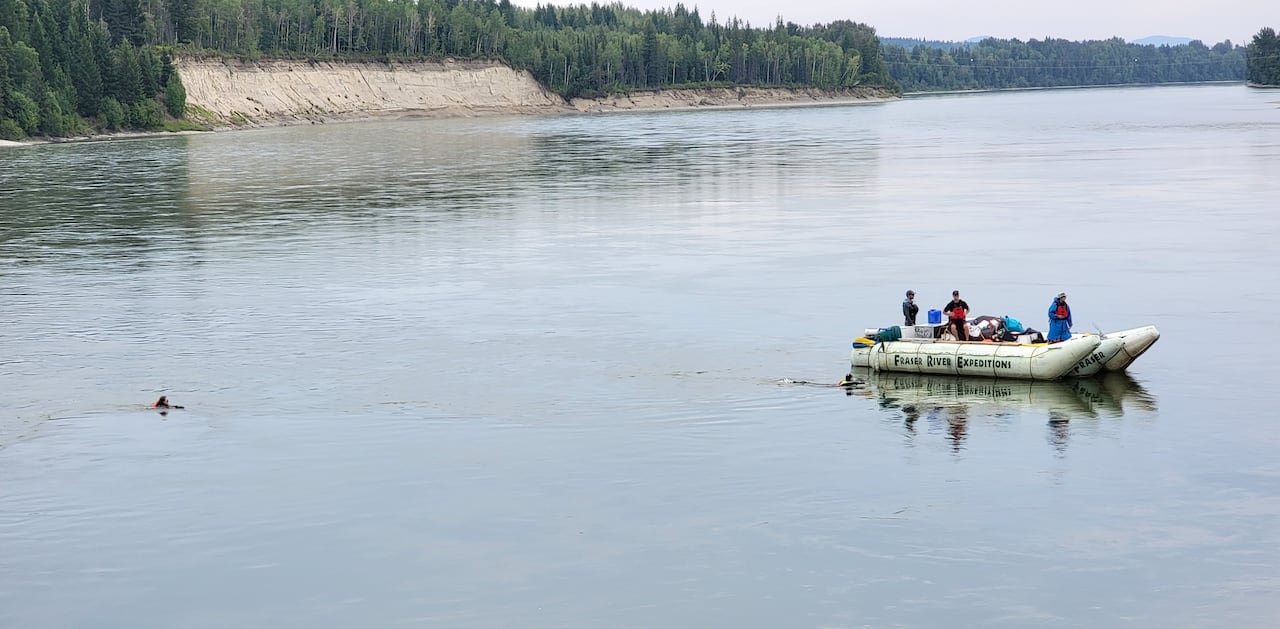
Naomi Devine, left, and Michelle Connolly, at the raft, swim to shore in the Fraser River at Prince George. (Jason Peters/CBC)
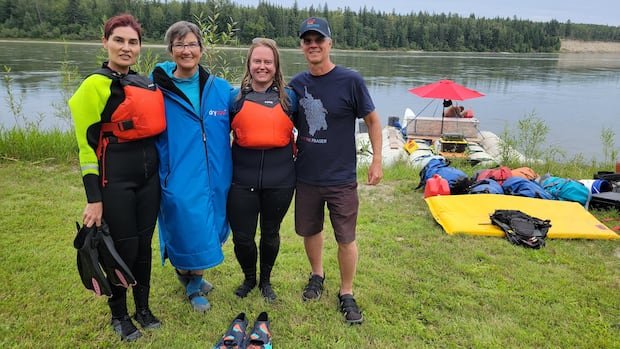
Joining Connolly are Naomi Devine from the Fraser Riverkeeper Society and Isabelle Côté, a professor of marine ecology at Simon Fraser University. Throughout the relay, swimmers from First Nations communities situated along the river have been contributing to fill a fourth position.
The team is retracing the same path that Fin Donnelly swam in 1995 and 2000. Donnelly, who served as the MLA for Coquitlam-Burke Mountain from 2020 to 2024, is now the leader of the Fraser Riverkeeper Society and is accompanying the current team in a supportive capacity.
Fraser River at a ‘crossroads’
The society states that this expedition represents the most prominent effort in a six-year initiative aimed at conserving 30 percent of the Fraser watershed by 2030. They highlight that despite the Fraser’s vital ecological, cultural, and economic roles, only 17.6 percent of its watershed is presently protected.
Donnelly emphasizes that achieving the goal of 30 percent protection requires collaboration with rights and title holders.
“There are 76 nations in the Fraser watershed and 75 municipalities,” Donnelly explained. “It’s a vast region with numerous dynamics at play. Our objective is to unite people to focus on protection. Many individuals are passionate about preserving this river for future generations.”
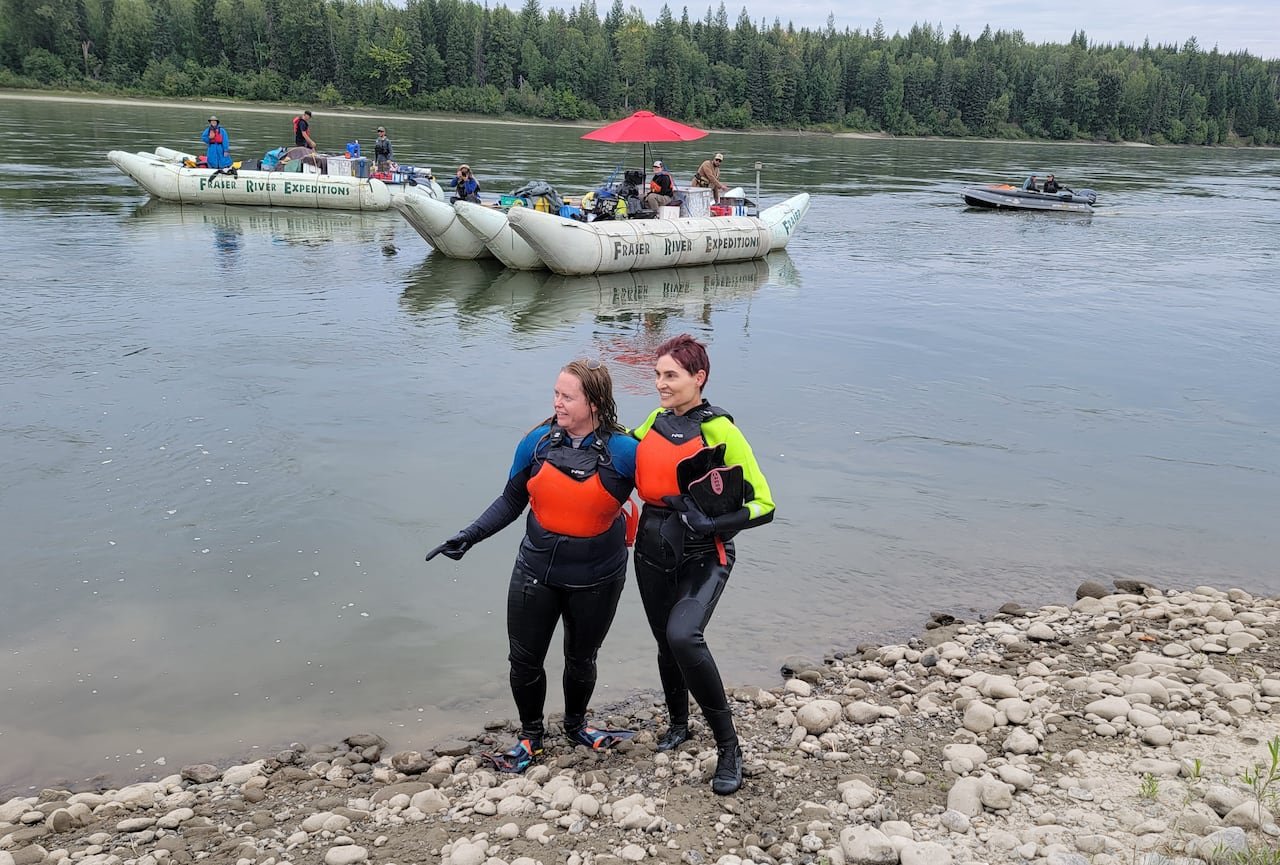
Relay swimmers Naomi Devine, left, and Michelle Connolly arrive on shore of the Fraser River in Prince George. (Jason Peters/CBC)
The society underscores that in addition to its significance for salmon—whose numbers are dwindling—the Fraser also supports forests, agriculture, wetlands, estuaries, communities, and urban areas.
They indicate that the Fraser stands at a “crossroads” due to habitat fragmentation from industrial development, and that the ecosystem is already under strain from warmer waters, droughts, floods, and wildfires exacerbated by climate change.
Swimmers covering about 40 km a day
The swimmers entered the Fraser for the first time on August 7 at Tête Jaune Cache, located near Mount Robson Provincial Park.
With the assistance of crew members on two large rafts and a smaller dinghy, they take turns in the water, averaging approximately 40 kilometres daily. By the time they reached Prince George, they had already covered close to 500 kilometres in just 11 days.
“Everything has gone remarkably well—though there have been some chilly, foggy mornings when putting on a wet wetsuit has been less than pleasant,” Connolly noted. “The Upper Fraser’s waters are quite cold. We’ve also experienced some scorching hot days, witnessed a variety of wildlife, and navigated through rapids. It’s been quite an adventure.”
In parts of the river that are too turbulent for swimming, the relay team either boards one of the rafts or exits the water completely.
Their final day in the water is scheduled for September 4, when they anticipate exiting the Fraser at Garry Point Park in Richmond.